
Thrive™
Pup to Partner -
Weeks 13 & 14
We start the foundation. Thrive helps you turn it into a great relationship.
Free with every Stony Lonesome pup
Testing the Edges
Rapid growth in mental and physical abilities naturally leads to your pup asking "how much control do I have?"
The Big Idea
At 13–14 weeks, your puppy is becoming more physically and mentally capable, more persistent, and more interested in discovering how the household works.
You might see selective listening, demand barking, jumping, grabbing clothing, harder biting (keep tugs handy), ignoring a familiar cue, or stubbornness in undesired behavior.
There are two main things going on here: first the puppy’s natural independence is growing, and growth is often a little awkward. Second, a pack animal will always want to learn the edges and nature of authority. If your puppy had a car, for a few weeks it might have a “question authority” bumper sticker.
This is all happening while he feels affection for you and craves your attention and loves the life you’re creating for him. But it still happens.
This is an exciting period because all the work that has been and will be put into building your pup’s capability and confidence and connection and carriage will really pay off in shaping the long-term relationship you want. Remember – the first 16 weeks are developmental opportunity gold.
Keep socializing in ever expanding situations. Field trips will improve behavior issues that come from boredom while building your relationship. And a strong relationship can help prevent and repair all kinds of problems.
Your puppy studies you moment by moment. They read our emotions with incredible accuracy, and they try to read our canine body anguage, but it isn't very good. We probably frustrate them with contradictions. In spite of this, your puppy tries hard to figure out:
- Which behaviors work?
- Does “No” really mean “No”? When and where?
- How do I get my minimum daily quotient of fun & exercise and good stuff?
- How much control can I get over food, play, movement, attention, and freedom?
- How does my owner respond to my different moods, especially excitement?
Allow the puppy to be a puppy and an individual – isn’t that part of the relationship you want? But it’s your job to communicate and shape good manners and general rules.
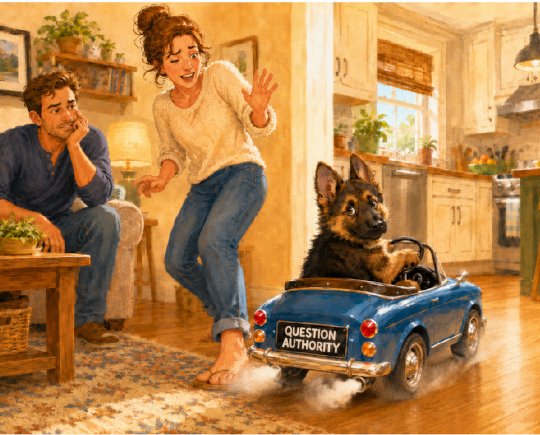
You may notice
Your puppy may:
- Push harder for attention
- Become more intense during play
- Mouth or nip when excited
- Ignore a recall around mild distractions
- Bark, jump, paw, or grab clothing to make something happen
- Protest when access is delayed
- Repeat a behavior to see whether the answer changes
- Become briefly frustrated by limits that were previously accepted
Don't lower your expectations, instead let's keep working on enrichment and on making your expectations clearer.
~ ~ ~
First, Context
1. Have a plan, and remember the big picture
There may be a few bumps in the road to shaping the partner you want, but staying focussed on the big piture always helps.
Make little plans - what you want to get out of every week, and even out of each day. Simple plans are enough, something like
"OK, this is 'Testing the Edges Week', so I'm going to keep things pretty low key & not try off-leash recall where the little guy might vanish. Instead we'll do the 'Please' thing a lot, keeping it playful, head over to Jennie's on Tuesday and Thursday because Max is good with puppies and she has a good fence, and when he's tire & hungry we'll do recall with those garlic-liver treats he loves. Max will probably help out too - he's well-mannered. The potty-training is going well, we'll stay hard on that, and he's getting better with the cat, I'll reward that. It's still touch-and go with the kitchen chair legs so I won't let him in the kitchen alone, that gate was easy to install, and I just love it when he makes eye-contact when I take out a new toy, and lately even when he sees the cat: 'look but do not taste'. He's not jumping on people, he plays well with nice dogs, things are going in the right direction!"
Making the most of each day for your pup is a great kindness – a day for you feels like a week or more (very, very roughly) for your dog in terms of development and lifespan. Carpe diem. (And thanks to Chi Luu we now know “Carpe” is better translated as “plucking and gathering of ripening fruits or flowers”.) Taking off 2 days from puppy enrichment may feel like half a month on his accelerated timeline.
Your plan to bring beauty and joy into your and your puppy’s life today makes it easier to deal with any speedbumps. A modest, executable day plan always beats no plan at all.
2. Keep the Rules Predictable and Consistent
Your puppy has been learning that certain behaviors consistently open doors – keep it up.
- A pause is the fastest way to the food bowl.
- Four on the floor earns attention and praise.
- A check-in may earn approval and connection.
- Releasing the toy may restart the game.
- Coming when called may lead to praise, play, food, or another chance to explore.
The exact rules matter less than their consistency.
Do not sometimes reward barking, jumping, biting, or frantic behavior because you are tired or in a hurry. Giving in once can invalidate weeks of consistency. Do you prefer your puppy to be thinking “I won’t waste my time - this has never worked” or “will this be the next exception”?
3. Interrupt/Redirect Early
You don’t want to micro-manage – that’s unhealthy, but you do want to be alert to prevent problems. Warning signs:
- Your puppy won’t look at you but is locked onto something
- Movements becoming faster, more jerky
- Biting becoming harder
- The puppy no longer responding to familiar cues
- Play becoming frantic rather than cooperative
- Repeated grabbing or jumping
- Difficulty disengaging
At that point, lower the intensity. Be calm and confident. Redirect to a toy, like a favorite tug you have in your pocket. Ask for a simple familiar behavior. Move to a calmer activity. It may be necessary to physically move the puppy or his head while withdrawing. You can blunt the unpleasant experience by doing all this with a cheerful attitude draws the puppy to you emotionally. Then give the puppy time to recover.
The quicker you catch these situations the better. We’re not punishing, we’re keeping things constructive and building good, positive habits.
4. Reinforce the Return
You don’t want to micro-manage – that’s unhealthy, but you do want to be alert to prevent problems. Warning signs:
- Your puppy won’t look at you but is locked onto something
- Movements becoming faster, more jerky
- Biting becoming harder
- The puppy no longer responding to familiar cues
- Play becoming frantic rather than cooperative
- Repeated grabbing or jumping
- Difficulty disengaging
At that point, lower the intensity. Be calm and confident. Redirect to a toy, like a favorite tug you have in your pocket. Ask for a simple familiar behavior. Move to a calmer activity. It may be necessary to physically move the puppy or his head while withdrawing. You can blunt the unpleasant experience by doing all this with a cheerful attitude draws the puppy to you emotionally. Then give the puppy time to recover.
The quicker you catch these situations the better. We’re not punishing, we’re keeping things constructive and building good, positive habits.
5. Miscellaneous
- Reinforcement is not only food. It can be praise, movement, distance, release, play, touch, or access to something the puppy wants.
- Continue to reinforce the choices you want repeated: check-ins, re-engaging, pausing to decide, giving up toys when asked, saying “Please”, moving with you on a leash, etc. Reward good habits intermittently. See Behavior Modification and Intermittent Reinforcement.
- Remain calm, positive and focused on the big picture so your attitude is constructive when things go wrong. Puppies react to our emotional state.
Puppy Skills to Grow
Your puppy has made a lot of progress! Keep reinforcing:
- Good choices - offer as many as you can!
- Say "Please" throughout the day
- Potty training - keep a priority
- Loose leash walking
- Handling: mouth, paws
- Recall
- The Redirect or Recover and Re-engage cycle
- Build routines your puppy will look forward to: bedtime, feeding time, getting ready for an outing - familiar is fun!
Owner Skills to Grow
- Keep improving your "puppy reading" skills
- Don't overload the puppy
- Correct appropriately. Overcorrecting shuts down all behavior from the puppy. Don’t weaken trust and connection – gently teach. Make sure the puppy understands what is being corrected.
- Encourage without pushing
- Say "Please" before access
- Good judgement : "Will this turn out well for my puppy?"
~ ~ ~
Let's Begin
This Week's Practice - be sure to read #4
“Please” and Tug are likely to be useful and fun daily. Recall is best practiced a few times a week, even if just for a couple of minutes each time. Training sessions are brief at this stage of accelerated learning.
1 of 5: Reinforce “Please” Before Access
Ask for a brief pause before giving the puppy something it wants.
Use ordinary moments:
- Before setting down the food bowl
- Before opening a door
- Before releasing the puppy from a crate or pen
- Before throwing a toy
- Before greeting
- Before allowing forward movement toward something interesting
This does not always require a formal sit.
The useful behavior may simply be:
- A pause
- Four feet on the floor
- A moment of stillness
- Eye contact
- A softened body
- A pause in barking
- Ask for a trick it knows (puppies love to show how smart they are)
The lesson:
Good things happen after that controlled feeling inside!
Do not demand a long wait. At this age a thoughtful second or two is enough.
2 of 5: Recall Away From Mild Distractions
Continue building recall, but begin using slightly more realistic distractions.
Call the puppy away from:
- A person standing nearby
- A toy that is not currently moving
- A scent in the yard
- Mild household activity
- A familiar dog at a safe distance
- An open doorway while the puppy is still able to think
Do not repeatedly call when you are unlikely to succeed.
Make the first calls easy enough that the puppy can win. Always aim for a win, even if it’s tiny.
Reward generously. Sometimes release the puppy back to what it was doing. This prevents recall from always meaning the end of freedom.
In addition to obedience, you are also training the habit of turning toward you. Build the habit (and protect it through judicious use) of following your command being more worthwhile and more interesting than distractions.
3 of 5: Give the Puppy a Useful Job
At any age, puppies and dogs benefit more from doing something with you rather than merely being prevented from doing things. Teach by including. The German Shepherd wants to have a role and to feel like he’s helping out and his efforts are valued.
It may sometimes be difficult to find a job for your puppy, but here are some ideas:
- Carry something, ex: a weed that you pulled in the yard. Tossing weeds is also a great way to play chase and catch.
- Finding scattered food (kind of like hunting)
- Following you through a few household tasks (a little conversation can engage the puppy, but don’t talk too much)
- Going to their mat/bed/crate (”Place” command)
- Walking with you to check the yard. German Shepherds of all ages seem to enjoy a perimeter check. This can be a part of the daily poop pickup. Also teaches the boundaries of the yard, what they need to protect.
- Helping gather toys
- Finding a familiar person
- Practicing one or two simple tricks
- Bringing a toy to restart play
- Sometimes ask them what they think – when they find an interesting smell or hear something in the distance, express interest in their investigation. Value their input.
The job does not need to be impressive to us, its value comes from giving the puppy a pattern:
Pay attention. Participate. Succeed with your person. You’re a vital part of our team.
~ ~ ~
4 of 5: Teeth, Tug, and Emotional Control
This is a serious topic - the #1 reason GSDs are put down is biting someone, whether or not it was their fault.
It can start with nipping and biting as a puppy. Nip it in the bud. Nipping often increases when puppies are:
• Overexcited
• Overtired
• Frustrated
• Seeking interaction
• Teething
• Unable to reach an appropriate toy
• Continuing play after they have lost control
Respond clearly and calmly:
- Stop movement.
- Interrupt access.
- Redirect to a game of tug when appropriate.
- End the interaction briefly if the puppy cannot regain self-control.
Look at the whole situation - not every bite is aggression.
- Does the puppy start to use its mouth on you when you rile it up? Don’t!
- Does your puppy start to nip when he’s tired? Sounds like it’s naptime! (But never use a crate as punishment – use your bedtime routine that the puppy likes.)
- Does the puppy nip one person more than the others in the home? That’s not OK. Someone might have to be a little more assertive.
- Does the puppy start to nip when bored on a day with low activity? Puppies need to burn off their energy. A day is too long a time for a puppy to be inactive!
Resume playing only when the puppy can participate more successfully. Call Stony Lonesome if nipping persists.
Tug
Tug gives a puppy an appropriate place to use its mouth while building engagement, confidence, cooperation, and control.
Tug well: use age appropriate force and let the puppy win sometimes. Encourage the puppy if interest fades. Pause before the game becomes frantic or boring.
During exciting play, a puppy may lose control and move from the toy to your hands, arms, or clothing.
Gently halt the game and calm down the puppy. Lovingly invite back into relationship - don’t get into a fight. When the puppy is thinking again and under control, continue the game, with the puppy’s mouth in the correct position.
An under-control puppy (also called “the return”) may:
- Lick your hand
- Soften its mouth
- Lean on you
- Offer a calmer response
- Ask appropriately for another round
- Re-engage with the toy properly
These are meaningful choices.
Mistakes are wonderful learning opportunities. Be a calm and loving leader. This is good practice for the long-term relationship you want with your dog.
Tug is a great way to address a nipping puppy. He wants to use his teeth? How about a game of tug?
Tug
Tug gives a puppy an appropriate place to use its mouth while building engagement, confidence, cooperation, and control.
Tug well: use age appropriate force and let the puppy win sometimes. Encourage the puppy if interest fades. Pause before the game becomes frantic or boring.
During exciting play, a puppy may lose control and move from the toy to your hands, arms, or clothing.
Gently halt the game and calm down the puppy. Lovingly invite back into relationship - don’t get into a fight. When the puppy is thinking again and under control, continue the game, with the puppy’s mouth in the correct position.
An under-control puppy (also called “the return”) may:
- Lick your hand
- Soften its mouth
- Lean on you
- Offer a calmer response
- Ask appropriately for another round
- Re-engage with the toy properly
These are meaningful choices.
Mistakes are wonderful learning opportunities. Be a calm and loving leader. This is good practice for the long-term relationship you want with your dog.
Tug is a great way to address a nipping puppy. He wants to use his teeth? How about a game of tug?
What to notice in the video
In the video, the puppy begins with a strong desire to tug, briefly needs encouragement, becomes overexcited, loses control and nips. I had a mild response with some verbal corrections, the puppy seems to agree to follow the rules, licks the hand, settles, and clearly wants to play again. I’m working on my videography skills – I’ll try to have the puppy in-frame more next time! The puppy became excited but the vocal corrections were enough.
This impromptu session shows:
desire → encouragement→ rising arousal → mistake → interruption → reconnection → renewed cooperation
This was unplanned and there was so much to say that I made the puppy wait longer than I normally would have. The return shows a strong desire to be in-relationship with the handler - notice the puppy’s softness. But when we restarted (after the video, unfortunately), the puppy was playful but gentle.
5 of 5: Continue to Reinforce
Continuing these earlier skills is important. For more details please review earlier Thrive™ chapters.
Continue:
- Short recalls
- Handling and grooming
- Leash familiarity
- Safe observation
- New surfaces, sounds, and places
- Check-ins around distractions
- Short outings
- Choice exercises
- Mild solvable challenges
- Recovery after surprise
- Calm rest after activity
The goal this week is not endless exposure, but a more consistent response. Keep reading your puppy.
~ ~ ~
And More Context
Boundaries Without Constant Conflict
A puppy needs limits, enforced without confrontation.
Whenever possible:
- Avoid the unwanted behavior, unless you want a teaching moment.
- Interrupt it early
- Redirect with energy and an attitude that inspires a puppy to follow you
- Reinforce the better choice
- Reduce freedom when the puppy cannot manage it well (ex: a puppy that isn’t house-broken shouldn’t be free to roam through your house)
- Try again later at a lower level of difficulty
A leash, gate, crate, pen, toy, chew, or change of environment can prevent repeated practice of behavior you do not want.
Repeated behavior becomes easier and more automatic. Do not allow the puppy to rehearse jumping, biting, demand barking, chasing, or repeatedly ignoring you and then expect one correction to erase it, or even to completely fix it in one day.
~ ~ ~
As Lou Reed
would say,
"Beginning
of a great
adventure."
~ ~ ~
Do Not Overload the Puppy
Keep reading your puppy. Look for signs of overwhelm. It can still happen, and as always, fear periods may pop up briefly. The skill of reading your canine companion 24x7 is just part of protecting and getting the most out of your relationship.
Continue to protect your puppy from:
- Pushy dogs
- Crowded greetings
- Uncontrolled children
- Overwhelming outings
- Repeated forced contact
- Excessive physical exercise
- Long training sessions
- Environments where the puppy cannot recover
Allow the puppy to notice, pause, and choose whenever safety permits.
Your puppy still needs your initial judgement of what is useful and what is simply too much.
A Common Mistake: Repeating Commands
Avoid the self-sabotage of repeating cues over and over at any age.
“Come. Come. Come.”
“Sit. Sit. Sit.”
“Leave it. Leave it. Leave it.”
Both you and the puppy will start to assume the first cue is optional, and then that all cues are optional. Set up for the first cue to work:
- Is the puppy able to hear me?
- Is the distraction too difficult?
- Have I taught this well enough here?
- Can I help the puppy succeed?
- Am I prepared to follow through?
Say the cue once, clearly and with authority, when possible.
Then help, move closer, lower the difficulty, use the leash, or change the environment.
Do not let your words become background noise.
What Progress Looks Like
Progress at 13–14 weeks does not look like perfect obedience – let's focus on the far-reaching area:
- The puppy pauses sometimes before acting
- The puppy redirects to a toy sooner
- A hard bite becomes a softer mouth
- The puppy recovers faster after frustration
- The puppy checks in before continuing
- The puppy releases the toy and restarts the game
- The puppy returns after noticing a distraction
- The puppy accepts a limit with less protest
- The puppy settles more quickly after activity
- The puppy begins choosing familiar household patterns without being prompted
- And of course keep socializing in ever-expanding situations
These small changes are the beginning of self-control.
Victories for This Fortnight
During Weeks 13–14, concentrate on:
• Clear, consistent household rules enforced & rewarded by everyone in the home
• Calm and early interruption before puppy stops thinking and starts reacting
• Protect when necessary.
• Appropriate outlets for biting and energy
• Build the recall skill by practicing around mild distractions
• Be intentional. What you reward, sometimes even what you pay attention to, grows.
• Recovery after mistakes
• Useful participation. You, little pup, are an important part of this important team!
Your puppy is learning how life with you works and at this time these lessons imprint deeply. Make it clear, fair, and one that the puppy will eagerly sign on to.
There may be some annoyances in the next few weeks as the puppy grows into its new abilities, that’s only natural, but you’re on track for great things!
Resources
•Recommended resources: Susan Garrett and her Shaped by Dog podcast. A world of excellent ways to break things down so your dog can understand. Susan respects dogs and works to develop true partnerships.
Administration
- Check collar regularly. Time to loosen?
- Car safety
- Keep up on nail trimming
- Contact Stony Lonesome GSD if needed
- Toy rotation - keep things fresh!