
Thrive™
Pup to Partner -
Weeks 15 & 16
We start the foundation. Thrive helps you turn it into a great relationship.
Free with every Stony Lonesome pup
Pup to Partner
Your joy in exploring and in spending time together leads to a deepening relationship
The Big Picture
The Purpose of Thrive™:
- to assist you in your journey toward the best family dog you’ve ever had by helping you
- Start the puppy-owner relationship well
- Continue the powerful enrichment that Stony Lonesome GSD began
- Navigate developmental stages and opportunities in months three and four
The terrific state of your relationship with your new puppy:
- Trust and familiarity are established
- You are learning to understand the puppy
- You are enforcing house rules to keep the puppy well-mannered and courteous
- Your puppy increasingly sees you as safe, reliable, interesting, useful, courteous and important to focus on
- A real partnership is beginning!
Near-term future:
- Sensitive early-development period winds down at the end of month four
- Juvenile development continues
- Adolescence approaches, with increasing independence, abilities, opinions, experimentation
- Current relationship-building helps prepare for that transition and will prove invaluable in working through any issues
- This final chapter of Thrive™ shifts from weekly instruction to serving as a template for the coming months as you develop your puppy and your relationship.
The Puppy’s Essential
Survival and Thrival Kit
Your puppy doesn’t need a country club membership, a personal chef or seventeen hours of scheduled enrichment every day. But the good life for a German Shepherd does require a few essentials:
- An hour or more of exercise most days — walks, tug, chasing balls in the backyard, romping with appropriate dog friends, exploring, training games and generally using that young body. It doesn’t all have to happen at once.
- Loads of quality time with you — play together, go places together, train a little, sit together, talk and listen. "Together" is the key. You are becomming the best thing in his world.
- Someone who listens and tries to understand what he is saying
- Something useful to do with that remarkable brain — problem-solving, scent games, training, searching, figuring things out.
- Pier play — with some friendly four-legged friends
- A new toy every so often — it could just be a cardboard box!
- Safe things to chew — save your fingers, shoes and the the dining-room table!
- An owner with the habit of noticing new places and thinking up (or reading about) new ways to play, new things to sniff.
- Challenge — spice for a puppy's life! How else to win victory and confidence so necessary to a German Shepherd?
- Clear, courteous rules — puppies are happier when the rules of the household don't change, and curtousy flows both ways.
- Chances to choose — let him investigate, think, choose and learn when it's safe.
- Fun with you — lots of it. Remember, puppies think even just riding to the store with you is a blast!
- Affection, safety and somebody he can depend on — underneath all the exercise, enrichment, training and adventures, this is still man's best friend. The reason for it all is a beautiful relationship!
And just like it feels so good to be liked for being you, he'll love to know that you like him because, deep down, he is himself.
~ ~ ~
The Opportunity Ahead
Continue puppy skill building
- Recovery
- Decision-making
- Engagement
- Connection
- Self-control / useful independence
Continue enrichment
Work all your knowledge of your puppy into fun enrichment. It’ll help with any bumps ahead
- Novelty
- Exploration
- Problem-solving
- Play
- Real-life experiences
Continue social exposure: people & dogs, mostly
- New people
- New dogs
- New environments
- At a distance is fine; greeting is not required
- Especially important for German Shepherds at this stage and as they mature
Notice emerging abilities & help him use them!
Puppies love to try out their new skills, and sometimes it looks a little like showing off!
- New physical skills
- New cognitive skills
- New social interests
- New drives / preferences
- Give useful outlets to abilities as they appear
Learn What Motivates Your Puppy
- Exploration
- Play
- Curiosity/Novelty
- Social Interaction
- Work / problem solving
Continue learning yourself!
- Read good trainers and behaviorists
- Classes / clubs / networking
- Experiment thoughtfully
- Compare ideas with what you see in your own puppy
- Use SL white papers as needed
- Read good trainers and behaviorists
- Classes / clubs / networking
- Experiment thoughtfully
- Compare ideas with what you see in your own puppy
- Use SL white papers as needed
Resources
At Ralf Weber's website and podcast, and in his book, "If Your Dog Could Talk", you'll find invaluable tips on why dogs behave as they do, a little about his training specialty, Play-Based Training, plenty on nutrition and a wide range of other important considerations often overlooked by others.
~ ~ ~
Let's Begin
Partnership Patterns for engaging the world
The Seven Pillars of Success With Your Puppy:
Your #1 Skill: Reading Your Puppy
Learning to discriminate:
- Need for help vs need for more time
- Interest vs worry
- Thinking vs reacting
- Productive frustration vs overload
- Fatigue / arousal
- Recovering vs needing redirecting
Learn What Your Puppy Likes — and Doesn’t
- Activities
- Environments
- Play styles
- People / dogs
- Physical challenges
- Mental challenges
- Competition (tug)
- Partnership (exploring together)
- Lying beside you
- A routine, ex: a bedtime routine
- Preferences can change from day to day and as puppy develops
Reading the Situation and the Puppy’s Response
- Is the event useful?
- Is the puppy calmly thinking or is it going straight to reacting?
- Is this a time to:
- Redirect?
- Allow?
- Wait?
- Guide?
- The same event on diffeent days may well require different responses
Learn When to Lead and When to Be the Supporting Actor
- Owner leads when safety / judgment requires it
- Puppy takes the main role when useful learning is possible
- Owner supports without stealing the scene
- Bring out the best in the event rather than controlling every detail. Get the big stuff right and don’t get tangled up in the details.
Create and Catch Learning Opportunities
- Recognize spontaneous opportunities:
- People
- Dogs
- Scents
- Noises, Wildlife
- Surprise Motion
- Objects
- Terrain
- Unexpected events
- Deliberately create:
- Small adventures
- Problems
- Novelty
- Games
- Training moments
- Fit enrichment into ordinary life rather than requiring formal sessions
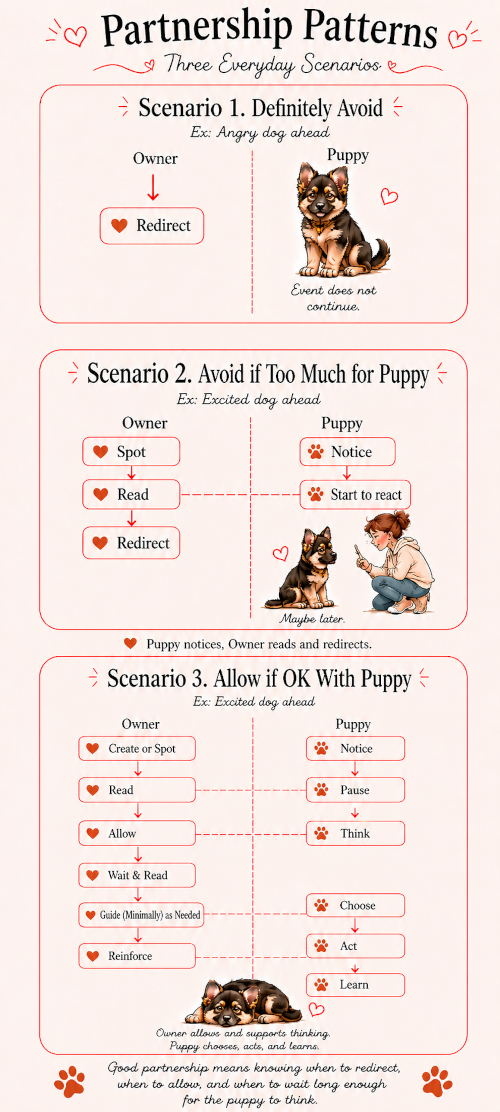
The Enrichment / Partnership Cycle – see image above
-
Puppy Enrichment Cycle
- Notice
- Pause
- Think
- Choose
- Act
- Learn
Owner Cycle
- Create / Spot
- Read
- Redirect or Allow
- Wait & Read
- Guide minimally as needed
- Reinforce
Three Scenario Pattern
- Scenario 1 — Definitely Avoid
- Scenario 2 — Avoid if Too Much for Puppy
- Scenario 3 — Allow if OK With Puppy
Protect and Build the Relationship
- Be aware of what weakens connection
- Be aware of what strengthens connection:
- Reliability
- Safety
- Fun
- Trust
- Mutual courtesy
- Respect for puppy’s interests and attempts at communication
- Shared success
- Thoughtful give-and-take
- Training and course-correction without making the relationship mostly correction
- Core principle: Better decisions + better guidance → richer relationship, not merely a “good dog”
~ ~ ~
What Success Looks Like
- Your puppy trusts you and looks to you when something interesting, confusing or difficult happens.
- He notices before reacting more often, even if the pause is still pretty short.
- He can get excited, worried or frustrated and recover reasonably well.
- He is increasingly willing to try things, solve problems and make choices.
- You can usually tell when he needs encouragement, more time, a little guidance or a redirect. The two of you are starting to work well together.
- House rules are familiar, even though your puppy occasionally believes they should be renegotiated.
- You are discovering what your puppy loves, dislikes and finds motivating.
- Training and enrichment increasingly feel like things you do together, not assignments.
- You are comfortable letting the puppy take the lead when appropriate and being the supporting actor.
- You aren't expecting perfection. Your puppy certainly isn't! Mistakes happen, you adjust, and everybody moves on.
- Your puppy is becoming more capable and independent without becoming less connected to you.
- Most importantly, you genuinely enjoy each other and can feel the beginnings of the partnership ahead.
- This is the payoff for the gradual, consistent investment you're making!
In Conclusion, From Pup to Partner
- Thrive is handing off rather than ending – you’re taking over now!
- The goal is not perfection, but good-enough action
- One or two useful things a day is enough. If you mess up for a couple of days just make yourself start back up today with something small.
- Keep:
- Trying
- Reading
- Playing
- Exploring
- Learning
- Adjusting
- Some experiences will work beautifully, others may not
- Both owner and puppy are still learning – the puppy will give you space to learn, and you will reciprocate
- Repeated shared experiences build:
- The dog
- The owner’s skill
- The relationship
- Partnership is the main prize – don’t sacrifice out of hastiness
- Avoid hasty forced-obedience
- Avoid rushing past a great learning moment
- Avoid pushing and shortcuts as much as possible – they demote your pup’s role and will be felt as such
- Carry this template forward through the next several months and into adolescence. You and your puppy are now setting your own course toward the dog and relationship you've always wanted!
Thrive™ mostly address the enrichment opportunities of puppies through month four. Stony Lonesome GSD customers with other questions should feel free to contact us!