
Information – Resources
You’re probably familiar with much of this, but hopefully you’ll find at least some of it useful. If these notes seem overwhelming simply start with the more important items that you can handle today (and what you can do will probably be enough!) and in time you’ll add more and more as you grow in the skills of dog ownership!
Resources
* Self-education is a major part of having the best dog ever. There are many different ways to learn including playing with your dog and paying attention. Here is just a start on the amazing resources available to help you learn to be the master that your best dog ever deserves!
* Talk with other dog owners everywhere you can
* There are many, many great resources, but here are a few more that we’ve learned from
— Avidog.com – Gayle Watkins, especially 97 ways to Create Great Puppies – please get this free download today!
— Before & After Getting Your Puppy, by Ian Dunbar – see below
— Calming Signals, by Turid Rugaas – see below
— Bones Would Rain From the Sky, by Suzanne Clothier – an incredible collection of the author’s experiences in becoming a dog whisperer/listener.
— The Other End of the Leash, by Patricia McConnell – about dogs, and more importantly their owners.
— Pure Dog Talk (Podcast), by Laura Reeves – great information from greats in the show and vet world. Very valuable information.
— Puppyculture.com has great resources on development and puppy handling
— Ian Dunbar is giving away three of his books in PDF form to promote his website, Dunbaracademy.com – mountains of training materials for something like $150 a year. “Before You Get Your Puppy” (101 pgs), “After You Get Your Puppy” (157 pgs), and “Good Little Dog” (140 pgs) all contain quality information, just not the number of topics and of course not the videos that you’ll find on his website. If you’re not familiar with Ian Dunbar, founder of Sirius Dog Training in Berkely in 1981, he was a relentless proponent for “positive training” for normal family pets. He encouraged owner & pet having fun while training instead of getting rough with your puppy, enrichment, early socialization and early training. Before Dunbar it widely believed that you couldn’t train a puppy before 6 months and that a main goal in training was submission. Here’s a link if you want to know more about him. SL GSD likes Ian Dunbar, and hopes you and your puppy will benefit from his material!
— Dogsbestlife.com – great free articles
Three books that Stony Lonesome highly recommends
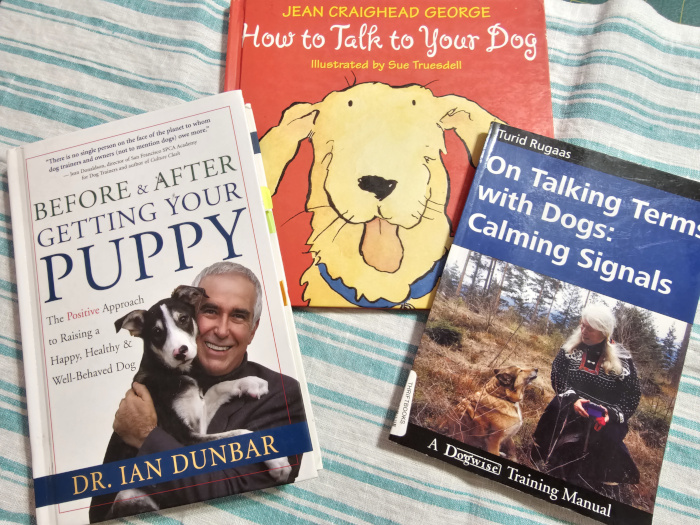
Recommendation #1: On Talking Terms with Dogs: Calming Signals by Turid Rugaas, published by Dogwise, 1997.
In about 70 pages this book will teach you how to start thinking from a dog’s point of view. In her splendid and sensitive work, Rugaas shows us how our dogs are constantly communicating with each other to avoid and resolve conflict (wolves have perhaps 15-30 distinct signals but most dog breeds have considerably fewer. Individual dogs may have none, depending on genetics or how they were started, GSDs do pretty well), but are also constantly trying to communicate with us.
If we don’t at least try to speak “doggish” we frustrate them all day long by seeming to ignore them as they try to tell us their fears and desires, make requests, just say “hello”, and when we’re stressed we may miss their telling us that everything will be ok.
Many years ago, before I’d read this book we had a puppy we loved very much at a training and daycare situation. When I came to pick up the puppy the woman who owned the facility wanted to show me how good she was with dogs and started jerking our puppy’s leash, sometimes actually lifting her off the ground to force her to go through a certain ritual before she’d let her come to me. The puppy just wanted to run to me.
She jerked the puppy around and got her into a sit. I saw the puppy gently look up at the woman and take her paw and lightly put it on the woman’s shoe. I asked the professional what that meant and she said “I don’t know, it’s nothing – just puppy nonsense” and jerked the puppy to end the contact.
I don’t think Rugaas covers that particular behavior, but after reading the book and seeing it a couple of times you’ll easily be able to figure out what it means in different situations (yes, it means different things in different situations) because you’ll have started speaking “Doggish”. Here’s an abridged list of the book’s topics.
Recommendation #2: Before & After Getting Your Puppy, by Ian Dunbar, 2004
Dunbar’s lengthy list of credentials makes him well suited to write this general primer on how to prepare for a puppy, how to work with your new puppy to avoid the big mistakes, and to set your puppy up for the life we all want for our dogs. Practical insight and advice on raising the dog you want, from the man most often credited with starting our culture toward positive dog training. A crash cours in topics such as getting your house ready for your new puppy, housebreaking, bite inhibition, socialization, the adolescent years and much more.
This is an excellent whirlwind tour of how to make the most of your first several months with your new best friend.
Recommendation #3: How to Talk to Your Dog, by Jean Craighead George, 2000, Harper Collins
Probably best known for “My Side of the Mountain”, George clearly loved and studied both dogs and children for decades to write this book. You simply must read it to your children/grandchildren. It’ll teach them how to really see a dog and open up emotional communication between them, which will make them great masters. Of course anyone who grows in human/canine communication should also grow in human/human communication.
One of my many favorite lines is “dogs love flattery”.
The illustrations are equally superb.
Even if you don’t have children or grandchildren, treat yourself to this book. It’ll deepen your understanding of and love for all things canine.
Brief AKC Manuals
Quick reads containing some good explanations of important subjects
AKC Manual – Emergency First Aid for Dogs
AKC Manual – Five Tricks You’ll Want To Show Off
AKC Manual – Agility for Beginners
AKC Manual – Canine Body Language
AKC Manual – Canine Good Citizen Test Items
AKC Manual – Life With a Senior Dog
AKC Manual – Puppy Food & Nutrition
AKC Manual – The Five Commands Every Dog Should Know
AKC Manual – Tips For Responsible Dog Owners
AKC Manual – Why Does My Dog Do That?